
For those just arriving at this website, Framing Speciesism is a research activism blog by me, Emily Major, that explores how we ‘frame’ (or think about) nonhuman animal species. The current project focuses on framing brushtail possums in Aotearoa New Zealand, which was the subject of my doctoral research at the University of Canterbury in Christchurch, New Zealand. I have dedicated my life to serve all species of animals, particularly those who are discarded, exploited, or demonised.
Earlier this week, I received a message from a friend about a breaking ‘Predator Free 2050’ (PF2050) update: Feral cats, referred to as “stone-cold killers”1, are now formally targeted by PF20502. As I clicked through to the article, I was dismayed (but not surprised), just as much as my friend, to see that the same media tactics which demonise possums3 are now being applied to feral cats.
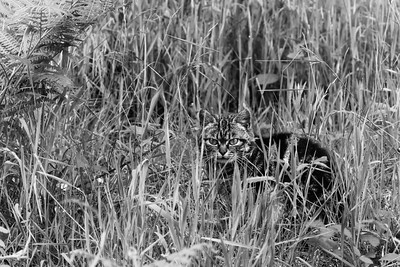
As with common media images of possums (see here), the pictures – which you can view by clicking the hyperlink above – hone in on snarling, hissing expressions that are surely used to evoke fear in the viewer. I cannot share the article’s exact image due to copyright issues, though the expression is similar in the CC image below. In my mind, these expressions are further evidence that fear is on behalf of the individual cats4, who are often pictured cowering in cages, sure to be killed after the image is taken. Other images in the article portray them devouring the carcasses of native birds, with the birds’ feathers bending unnaturally. The viewer is intended to associate the snarling aggressor (the feral cat) with the helpless victim (the bird). The emotive language paired with these images stated that feral cats were now added to the “hit list” – their words, not mine.

The article also includes an image and quotes by the current Chief Executive for the Predator Free New Zealand Trust, Jessi Morgan. Morgan, smiling broadly in the supplied image, shared how happy she was that feral cats were finally included in the PF2050 goal. Though I could tease through more of the article, I was particularly struck by the following quote, which stated,
“There’s understanding that feral cats are a completely different kettle of fish to the cats that are sitting on your lap at night watching Shortland Street with you.”
In Aotearoa New Zealand, there are three sections of cats within the felis catus species5: cats who are companion animals and are fully cared for by humans, stray cats who are partially cared for by humans, and free-roaming feral cats who are not cared for by humans at all. This lack of human relationship appears to be the first of many sticking points for justifying the eradication of feral cats, according to Predator Free NZ6. Cats are obligate carnivores, meaning they must eat animal protein to survive. If they do not have access to human care, they will – obviously – seek out food for themselves. Poignantly, some of the species targeted as food by these cats (particularly native species) are valued for their role within New Zealand society, making their predation morally unacceptable for many New Zealanders. As such, feral cats – not pets – easily become ‘pests‘7 worthy of eradication.
While I could pick apart Morgan’s quote further (and continue this discussion beyond just this quick read), the demarcation of a good cat versus a bad cat means the difference between life and death. Cats who enjoy iconic Kiwi television and who are fed tins of ‘appropriate’ animal proteins (i.e., fish or farmed poultry) are the epitome of good, while those who exist in the wild and eat what they catch in order to survive are the epitome of bad. This dramatic framing is, unfortunately, not a surprise.

As with possums, this framing objectifies feral cats as objects whose destruction is justified. Their dead bodies are paraded in images online to show how conservation authorities (i.e., the heroes of the story) are successfully combating the offending felines. For example, official Department of Conservation messaging reinforces how feral cats are predators of native species. Their webpage shares images of dead feral cats lying alongside (native) animals they have killed5. This situation is further complicated by the status of cats in New Zealand, where they are treasured as family pets in one context, but the very same species is demonised in the wild8.
As with all my arguments around conservation, my advocacy for ‘pests’ does not mean that I do not support the protection of native species. These two concepts are not mutually exclusive, and they shouldn’t be. What weighs heavily on me is that the outcomes most associated with this militaristic form of conservation can lead to cruelty disguised as conservation. We have seen this with possums9, and now we are starting to see it with cats, too (such as the 2023 North Canterbury cat hunting competition, which became internationally criticised due to children killing not only feral cats, but pet cats, as well10).

Again, it is important to clarify that this does not mean all conservationists, or people who want to protect native species, will actively participate in cruelty for cruelty’s sake. Cruelty has become so normalised within conservation and conservation rhetoric in New Zealand that many actions are not seen as cruel. Even my suggestion to consider compassion for ‘pests’ within conservation has previously been seen as a direct threat to the cause of protecting native species.
Ultimately, conservation messaging needs an entire overhaul. The goal of protecting native species is a worthwhile and incredibly important endeavour, but we will not truly be addressing the root causes (which are often directly human-induced due to our selfishness and sense of superiority) without recognising the damage this kind of rhetoric has, not only on the ‘pest’ species themselves, but people, too.
References:
1 Hancock, F. (2025, November 20). ‘Stone cold killer’ feral cats added to Predator Free 2050 strategy, Conservation Minister announces. Radio New Zealand. https://www.rnz.co.nz/news/political/579503/stone-cold-killer-feral-cats-added-to-predator-free-2050-strategy-conservation-minister-announces
2 Department of Conservation. (n.d.). Predator Free 2050. https://www.doc.govt.nz/nature/pests-and-threats/predator-free-2050/
3 Major, E. (2024). Slayers, rippers, and blitzes: Dark humor and the justification of cruelty to possums in online media in New Zealand. Frontiers in Communication, 9, 1377559. https://www.frontiersin.org/journals/communication/articles/10.3389/fcomm.2024.1377559/full
4 Rigterink, A. (2022). Fear, anxiety, stress behaviors in cats. Clinical handbook of feline behavior medicine, 129-141. https://onlinelibrary.wiley.com/doi/abs/10.1002/9781119653271.ch8
5 Department of Conservation. (n.d.). Feral Cats. https://www.doc.govt.nz/nature/pests-and-threats/animal-pests-and-threats/feral-cats/
6 James, A. (2025, May 21). Brutal Truths: 7 Feral Cal Facts. Predator Free NZ. https://predatorfreenz.org/research/predators/brutal-truths-7-feral-cat-facts/
7 Glen, A. S., Edwards, S., Finlay-Smits, S., Jones, C., Niebuhr, C. N., Norbury, G. L., & Samaniego, A. (2023). Management of cats in Aotearoa New Zealand: a review of current knowledge and research needs. New Zealand Journal of Ecology, 47(1), 3550.
8 Department of Conservation. (2025, November 21). Feral cats to be added to Predator Free 2050. https://www.doc.govt.nz/news/media-releases/2025-media-releases/feral-cats-to-be-added-to-predator-free-2050/
9 Roy, E. (2017, July 5). New Zealand’s possum war: ‘barbaric’ drowning of babies at school fair sparks outcry. The Guardian. https://www.theguardian.com/world/2017/jul/05/new-zealands-possum-war-barbaric-drowning-of-babies-at-school-fair-sparks-outcry
10 Gee, S. (2023, April 18). North Canterbury hunting competition encouraged children to shoot feral cats. Radio New Zealand. https://www.rnz.co.nz/news/national/488210/north-canterbury-hunting-competition-encouraged-children-to-shoot-feral-cats
Copyright © 2025 Framing Speciesism. All Rights Reserved.
Framing Speciesism will happily authorise credited reproduction of this content, given prior permission has been obtained. Please use the ‘Contact’ tab to inquire about more information.

 Framing Speciesism

Leave a comment