

For those just arriving at this website, Framing Speciesism is a research activism blog that explores how we ‘frame’ (or think about) nonhuman animal species. Beginning with my doctoral research on brushtail possums in Aotearoa New Zealand, my work has since expanded to include a wider breadth of species, particularly those labelled as ‘pests’, ‘invasive’, or ‘unwanted’. I am developing Critical Pest Studies, an emerging subfield of Critical Animal Studies that examines how these labels are socially and politically constructed and how they shape public attitudes, policy, and the treatment of animals. Through this work, I challenge the narratives that justify the persecution of certain species and dedicate my research activism to serving animals of all kinds, particularly those who are discarded, exploited, or demonized.
October 12, 2026
“Albertans have enjoyed living without the menace of rats since 1950 when the Rat Control Program was established.” — Government of Alberta
I often consider New Zealand’s attitudes to ‘pests’ to be unmatched. Perhaps this is due to how long I have studied that particular space and how deeply embedded I am in critiquing its unique ‘pest’ culture. However, as I am beginning to develop Critical Pest Studies, I am noticing how similar this culture is to other examples around the world, such as the provincial rat control program in my home country of Canada.
I knew Alberta had a rat ban, but I didn’t look into it much at the time. This was not because of disinterest or not caring for them; rather, it was the exact opposite. I have a deep affection for rats and feel they are deeply misunderstood and unjustifiably villainized. I have also shared many years of my life caring for them as treasured family members. Truthfully, I am still not fully healed from the immense grief of losing them, so I suppose critiquing rat ‘pest’ cultures is something that I have (unintentionally) kept at a distance, though I am starting to prod at it now. It helps there are other scholars discussing rats and their conflicting place in the world (McCumber, 2025; Nagy & Johnson, 2013).
In late September 2026, a dead rat was discovered in Bowden, Alberta (Franklin, 2026), prompting a response from the provincial rat control program. Alberta is one of the few places on Earth with a dedicated rat extermination program and rats are illegal to be kept as pets. The public is heavily encouraged to report any sightings or evidence of rats so that the animals can be killed. Mind you, this doesn’t stop universities, colleges, zoos, and research institutions from holding specialized permits that allow them to be exploited in captivity (Government of Alberta, n.d.).
After hearing about the discovery of the rat, I began researching the ban on the Government of Alberta website to see how they frame the issue themselves. I found myself floored by the similarities between these anti-rat campaigns and anti-possum ones in New Zealand.
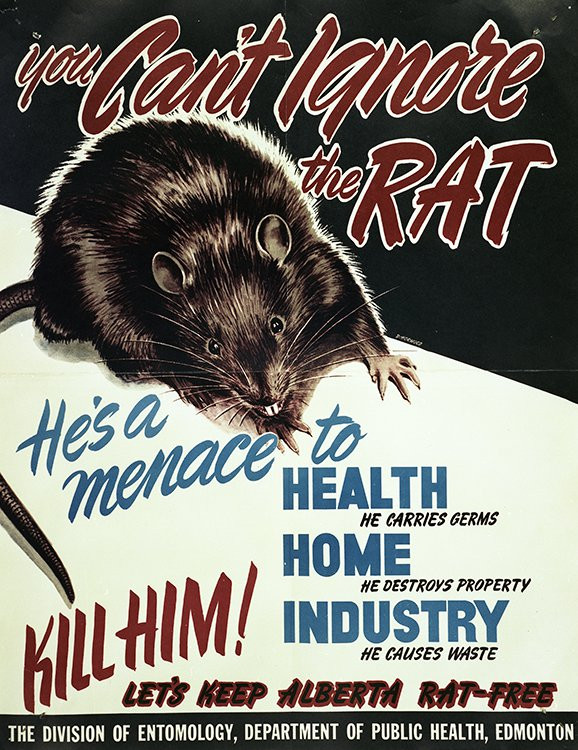
For example, you can see the particular framing of rats as villains in the image above, which is a Department of Public Health poster from 1948. The text reads, “you can’t ignore the RAT”, and lists three key areas where they cause issues: health (through germs), home (through destroying property), and industry (through waste production). At the bottom, “KILL HIM” is written in large capital letters, encouraging the province to become rat-free. Interestingly, the rat is identified using he/him pronouns, which seems at odds with the rest of the objectifying language, but that is a slight digression.
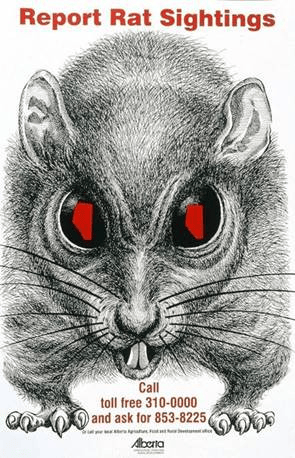
In another governmental poster from 1990, a rat stares menacingly at the viewer. Their bulbous, black eyes mirror a bright red provincial outline of Alberta, and they appear to be sneering with aggression. The poster simply asks the public to report rat sightings and provides a telephone number for doing so.
Critical Pest Studies
As I sit here typing this post, I begin to tie this example back to Critical Pest Studies and how animals can be constructed as threats, and how these threats have evolved to deanimalize them and ultimately can justify cruelty. I wonder how fear can shape public policy, and why killing some animals is celebrated as a public achievement rather than being recognized as an ethical and moral concern of disposability.
The category of ‘pest’ does more than describe an animal or groups of animals. It places them within a human-designed framework of governance where their presence is understood as a problem that humans must manage, and their eradication is presented as the ideal solution.
This is a central concern of Critical Pest Studies. It examines how animals, such as rats, come to be classified as ‘pests’, ‘vermin’ (Cecco, 2026), ‘invasive’ (Alberta Invasive Species Council, n.d.), or ‘unwanted’, and how these classifications shape public attitudes, policy, and the (mis)treatment of animals. The designation can make a complex relationship between humans, nonhuman animals, and environments appear straightforward. An animal is identified as a threat, their presence becomes evidence of a particular problem, and their (usually lethal) removal becomes justified.
Politics of Belonging
In mainstream conservation, Alberta’s rat control program is widely understood to be a public-policy success (Agriculture and Agri-Food Canada, 2024). However, the more I examine it, the more I see how animal management becomes entangled with ideas about territory, belonging, and invasion. This is not at all different from the context of possums in New Zealand.
Rats, like possums, are described using militaristic language, suggesting that these animals are invading human spaces and penetrating places where they do not belong. The rat discovered in Bowden became significant not simply because they were dead, but because their presence raised the possibility that Alberta’s carefully maintained boundary had been breached.
When language relies on words such as vermin, menace, invasion, and infestation, it positions these animals within narratives of impending danger and contamination, making their removal justifiable (if not desirable). Critical Pest Studies, drawing from anti-speciesism, challenges the assumption that an animal’s classification should determine the extent of our ethical concern.
Now, this does not mean pretending that rats and humans can always coexist without conflict (though it would be nice as rats can be great friends). It means recognizing that an animal can pose a problem without becoming morally disposable. This is not an argument for abandoning environmental care or ignoring public health, but rather an invitation to examine why conflicts between humans and other animals so often end with certain animals being treated as though their lives do not matter.
Through Critical Pest Studies, they do matter, and it’s important for us to question the narratives that tell us otherwise. We need to look beyond the labels we assign to animals and consider how those labels shape the lives they are permitted to live, the violence they are subjected to, and the compassion they are denied.
References:
Agriculture and Agri-Food Canada. (2024, November 5). Encouraging Albertans to “Rat on Rats!” [Press release]. https://www.canada.ca/en/agriculture-agri-food/news/2024/11/encouraging-albertans-to-rat-on-rats.html
Alberta Invasive Species Council. (n.d.). Rat on Rats! https://abinvasives.ca/rat-on-rats/
Cecco, L. (2026, September 25). Alberta’s self-image as world’s only rat-free region shattered by discovery of rat. The Guardian. https://www.theguardian.com/world/2026/sep/25/alberta-canada-rat-patrol
Franklin, M. (2026, September 25). Dead rat found in Bowden, Alta.; officials call in Rat Patrol. CTV News. https://www.ctvnews.ca/calgary/article/dead-rat-found-in-bowden-alta-officials-call-in-rat-patrol/
Government of Alberta. (n.d.). Alberta’s Rat Control Program. https://www.alberta.ca/albertas-rat-control-program
Government of Alberta. (n.d.). Pest and Nuisance Control Regulation. https://open.alberta.ca/publications/2001_184#summary
McCumber, A. (2025). Bad Nature: How Rat Control Shapes Human & Nonhuman Worlds. University of Chicago. https://press.uchicago.edu/ucp/books/book/chicago/B/bo244056007.html
Nagy, K., & Johnson, P. D. (Eds.). (2013). Trash animals: How we live with nature’s filthy, feral, invasive, and unwanted species. University of Minnesota Press. https://www.upress.umn.edu/9780816680559/trash-animals/
Copyright © 2026 Framing Speciesism. All Rights Reserved.
Framing Speciesism will happily authorize credited reproduction of this content. Please use the ‘Contact’ tab if you have any questions.



Leave a Reply